Category: Family Moments

  • One Phone-Free Weekend: A 48-Hour Plan

    One Phone-Free Weekend: A 48-Hour Plan

    One weekend. Friday night to Sunday night. Phones wait, and the family finds out what fills the space.

    That is the whole experiment. Not a detox, not a challenge, not a test of willpower — a weekend. Forty-eight hours is long enough to feel different and short enough to say yes to. If it goes well, you will know by Sunday night. If it does not, Monday morning is right there, and nothing was lost except a weekend of scrolling.

    Parents and children on a walk together, enjoying a screen-free weekend afternoon

    Why a weekend

    A single phone-free dinner is a moment. A phone-free weekend is a shape. It has a beginning, a middle, and an end, and everyone in the family can feel the shape of it. The first hours are the hardest — the hand reaches for the phone before the brain catches up. By Saturday afternoon, the reaching stops. By Sunday, most families notice something they did not expect: the time got longer. Not the hours — the moments inside them.

    A weekend also solves the problem every family experiment has: when does it end? This one ends Sunday night, after dinner. Everyone knows. Nobody has to negotiate an exit.

    Friday night: set it up together

    Agree on it over dinner. Pick the weekend together, at the table, with the phones already in the basket. Let everyone, including the adults, say yes. If someone is not ready, pick a shorter version — Saturday only. A weekend the family chose is a weekend the family keeps.

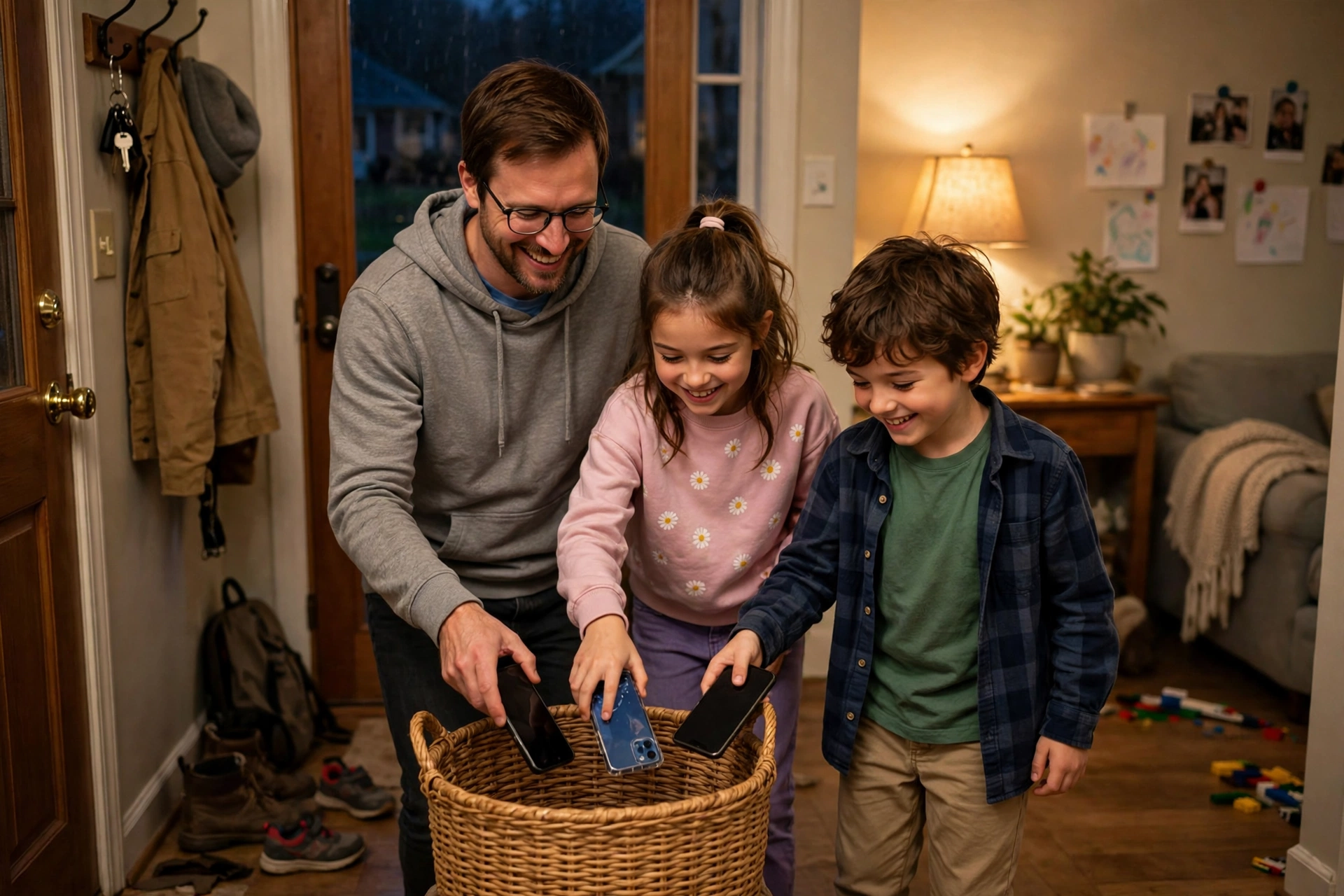
    Give the phones a place to sleep. One charging spot, outside the bedrooms. The same basket from your screen-free zones, in the same place. The point is not hiding them. It is a small, visible pause everyone can see.

    Plan one thing, not ten. One outing for Saturday, one slow thing for Sunday. The rest of the weekend can be unplanned. Overplanning a phone-free weekend just replaces the screen with a schedule.

    Tell the outside world. One message to grandparents, one to the group chat: “We are phone-free this weekend — call the house if you need us.” Then the phone can wait in peace, and so can you.

    Saturday morning: the first hours

    The first hours are the awkward ones. The hand reaches. The thumb scrolls thin air. That is normal — it is a habit, not a hunger, and habits fade fastest when something else fills the hands.

    Start with breakfast together, phones still in the basket. Then the simplest thing there is: go outside. A walk, a park, a yard. The morning does not need a plan; it needs a door. If the weather is bad, the kitchen works just as well — pancakes, a puzzle on the table, music from a speaker instead of a screen.

    By late morning, the reaching will have mostly stopped. That is when the weekend begins.

    Saturday afternoon: go somewhere

    Go somewhere that is not your house. A trail, a library, a farmers market, a friend’s backyard — anywhere the family has to be together in a place that is not built around a screen. The car ride there is part of it: phones in the seat-back pocket, one open question, and the road.

    Let the kids choose the destination. A weekend the kids chose is a weekend the kids remember. And bring a ball, a book, or a deck of cards — something for the hands that used to hold a phone.

    Saturday evening: the slow part

    Saturday evening is the heart of the weekend. Cook together, or order in and eat at the table — a phone-free dinner, with the basket in its place. Then the slow part: a board game, a story read out loud, or just the table with nowhere to be. Try one of our 28 conversation starters if the table goes quiet. “What was the best part of today?” is enough. The conversation does the rest.

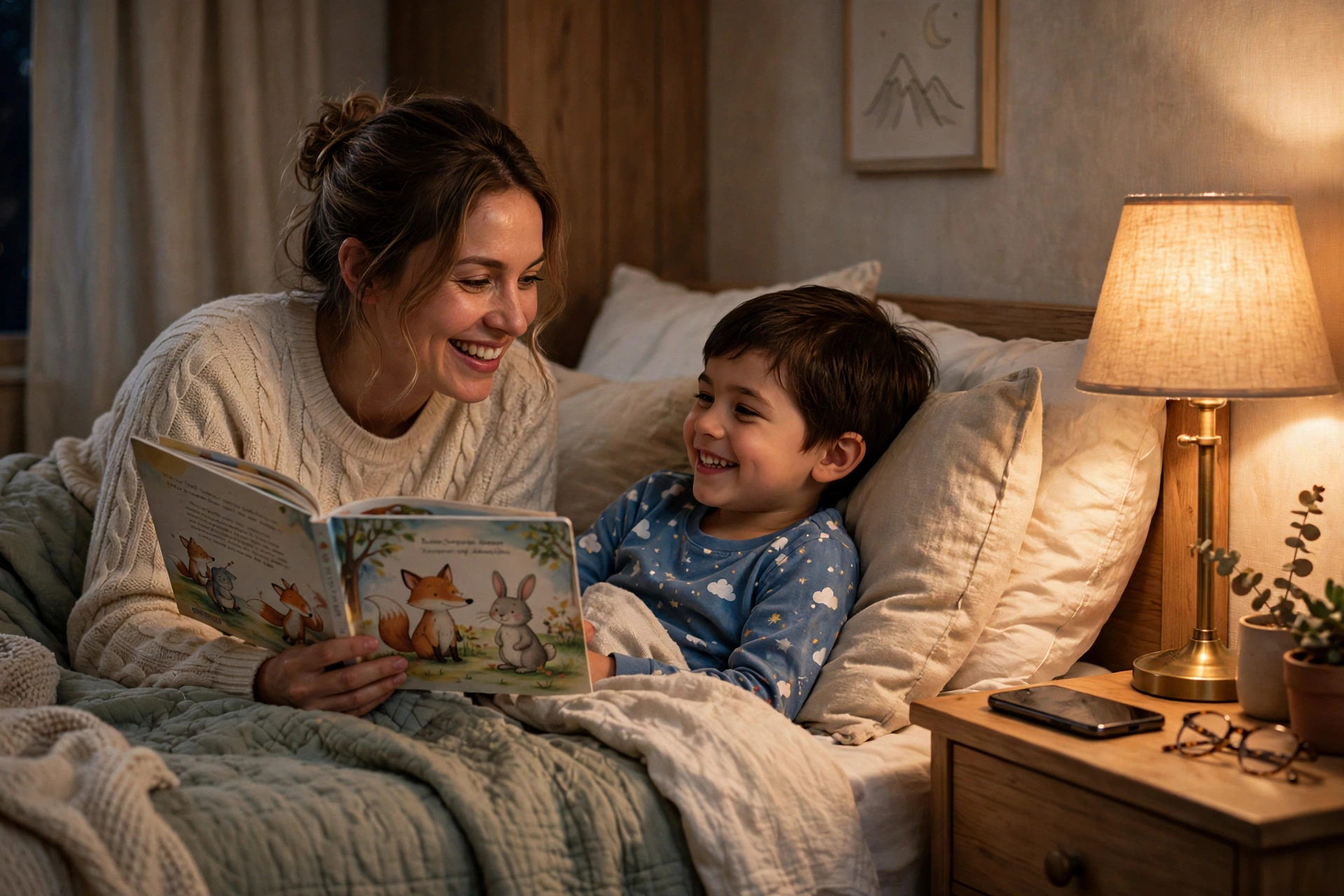
    Bedtime is the same as any phone-free bedtime: one story, read out loud, phones charging outside the bedrooms. The weekend’s best moment might be this one — the house quiet, the story finished, and nobody reaching for anything.

    Sunday: bring it home

    Sunday is for the slow things the week never has room for. A long breakfast. A walk. A project on the kitchen table — the family media plan, if you have not made one yet. Sunday is a good day to write it, because by Sunday the family knows what the plan is for.

    Before dinner, sit down together and ask three questions: What was the best part of the weekend? What was the hardest part? What do we want to keep? Write the answers on the back of the media plan. That is the weekend, kept.

    Sunday dinner is the closing ceremony. Phones come back after dinner, not before. One last phone-free meal, and then the basket empties — on purpose, together, not one phone at a time in secret.

    If it gets hard

    It will get hard, somewhere around Saturday morning, when someone is bored and the phone is right there. Boredom is not a failure of the weekend. It is the weekend working. Boredom is the space where a child decides what to do next — and they can only decide that if nobody fills it first.

    If a real need comes up — a work call, a sick relative, a teenager waiting on a message that matters — take the exception. Step outside, take the call, come back. The weekend is a ritual, not a rule. The plan bends; the moment stays.

    And if the whole weekend falls apart by Saturday lunch, that is not failure either. Take one thing from it — one phone-free dinner, one walk, one story — and keep that. Next time, the weekend will be easier, because the family will know what it feels like.

    A small pause, not a punishment

    We are not anti-phone. We are pro-family moments. The goal is not to quit screens or to feel guilty about the ones already in your home. It is to protect one small stretch of time where connection already wants to happen — and to find out, together, what fills it.

    If one phone-free weekend goes well, try another next month. And if you would like to be part of what comes next, join the waitlist and help shape the first phone-free ritual. Read more about why these moments matter.
  • How to Make a Family Media Plan in 6 Steps

    How to Make a Family Media Plan in 6 Steps

    Every family already has a media plan. It is just unwritten — a pile of habits, arguments, and silent compromises that nobody agreed to and everybody resents a little. Writing it down changes that. A written plan turns a daily negotiation into a shared agreement, and it gives the whole family — adults included — something to point at.

    This is the plan we have been pointing toward since the site began. It takes one evening, one sheet of paper, and everyone at the table.

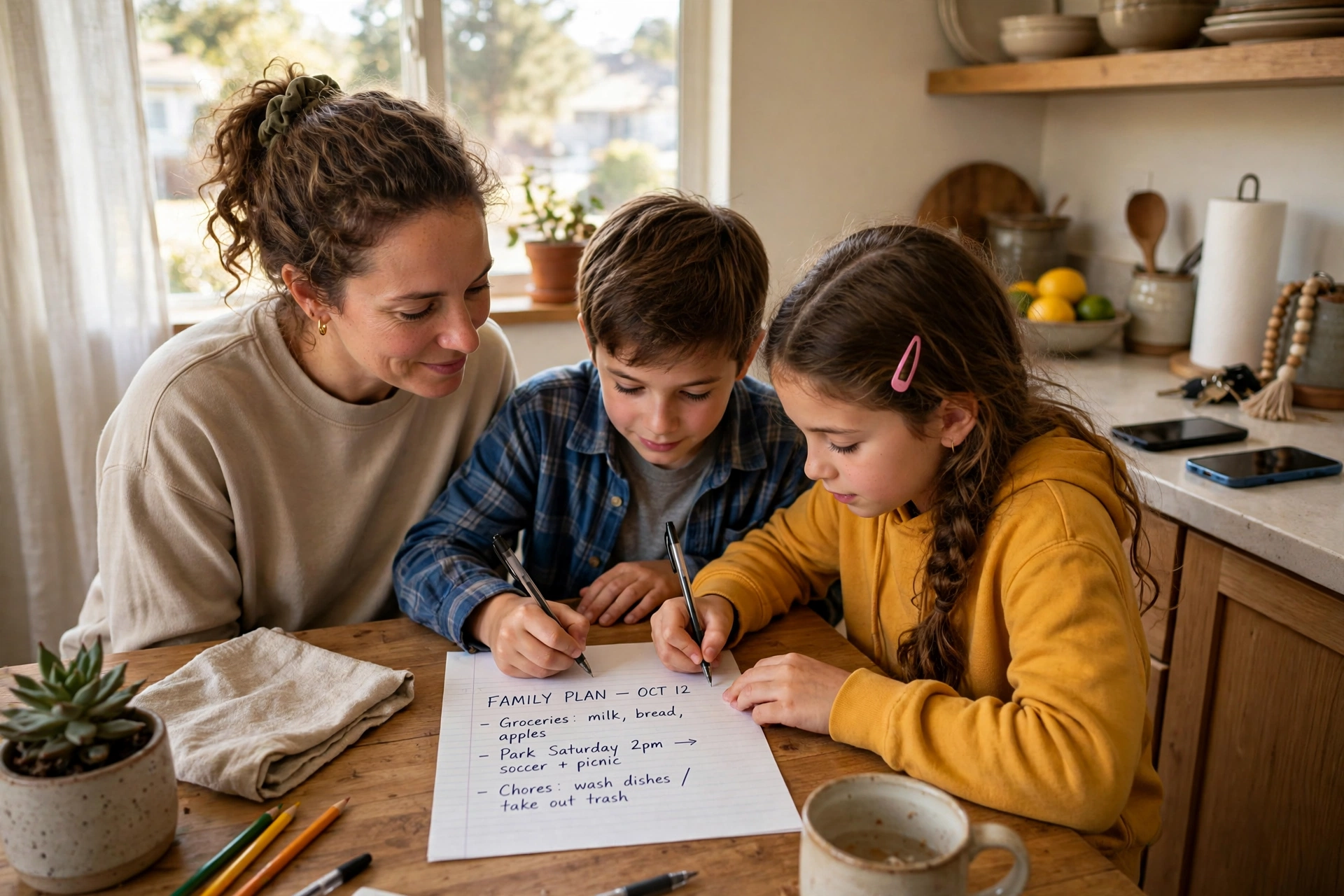
    Parents and children writing their family media plan together at the kitchen table

    What a family media plan is (and isn’t)

    A family media plan is a short, written agreement about when and where screens are welcome in your home, and when and where they wait. The American Academy of Pediatrics has recommended that families make one since 2016, and they offer a free tool to build it: the AAP Family Media Plan on HealthyChildren.org, which walks through the same choices step by step.

    What it is not: a contract, a punishment, or a set of rules handed down by the adults. The plans that last are the ones the whole family builds together, in plain language, on one page. If it takes more than a page, it is too long to live on a fridge.

    Start with the 5 Cs

    Before you write a single rule, the AAP offers five questions worth asking about any screen decision. They call them the 5 Cs, and they are a better starting point than a clock:

    Child. Who is this particular child — their age, temperament, and needs? Not every child needs the same plan.

    Content. What are they actually watching, playing, or interacting with? Quality matters more than minutes.

    Calm. Are screens the main way this child settles big feelings or falls asleep? If so, what else could help?

    Crowding out. What is the screen pushing aside — sleep, play, reading, family time, time outside?

    Communication. Do you talk about media early and often, so problems surface while they are still small?

    Run each of your family’s screen habits through those five questions. The answers will tell you where the plan needs to be firm and where it can be generous. The AAP’s 2026 policy statement makes the same shift: away from a single hour limit for every child, and toward the child, the content, and the conversation.

    The six steps

    Step 1 — Pick one evening. Not a lecture, not a family meeting with an agenda. Dinner, then the plan. Twenty minutes is enough. Phones in the basket first — the adults’ too. (Our screen-free zones piece is the warm-up for this.)

    Step 2 — Name the moments that stay phone-free. Start with the three we have written about: the dinner table, the bedroom, and the car. Let each person name one moment that matters to them. Write them down exactly as the family says them.

    Step 3 — Name the places phones wait. Every zone needs a visible spot: a basket by the door, a charging station outside the bedrooms, a box on the kitchen counter. The point is not hiding the phones. It is a small, visible pause everyone can see.

    Step 4 — Agree on the edges. What happens when a grandparent video-calls at dinner? When homework needs a tablet? When a teenager is waiting for a message from a friend? Write the exceptions in. A plan with no exceptions is a plan that breaks the first time life happens.

    Step 5 — Write it on one page. Three zones, three phone spots, three exceptions, and one line at the bottom: “We made this together.” Sign it — all of you, including the kids. A signature is not a legal document. It is a memory of having chosen together.

    Step 6 — Put it where everyone can see it. The fridge. The hall. The inside of the front door. A plan in a drawer is a plan that does not exist.

    The one-page plan

    Here is the template. Copy it onto a sheet of paper tonight — or print this page and fill it in together:

    OUR FAMILY MEDIA PLAN

    Our phone-free moments: 1) Dinner — phones in the basket. 2) Bedtime — phones charge outside the bedrooms. 3) Car rides — phones in the seat-back pocket.

    Where phones wait: The basket by the door / the charging spot in the hallway.

    Our exceptions: Video calls with family. Homework on the tablet. Emergencies, always.

    Our promise: The adults follow the plan too. We review it together every season — and we change it together when it stops working.

    Signed: ____________________ (everyone signs)

    That is the whole plan. It fits on one page because a plan only works if everyone can remember it.

    What about the numbers?

    Parents always ask for the number, so here is what the guidance actually says. For children under 5, the World Health Organization’s 2019 guidance is specific: no screen time for infants under 1, no sedentary screen time at age 1, and no more than 1 hour a day at ages 2 to 4 — and less is better. For children 6 and older, the AAP does not set one universal daily hour limit. Its 2026 policy says plainly that media and children cannot be addressed through time limits alone, and asks families to weigh the quality of the media, what it crowds out, and whether anyone is talking about it.

    That is why the plan above has no hour count in it. The zones do the work the clock never could.

    Review it together, every season

    A plan is a living thing. Kids grow, schedules change, a new device arrives, a new school year starts. Every season — four times a year, over dinner — take the page off the fridge and ask: what is working, what is not, and what should we change? Let the kids propose the changes. The review is the point. A family that revisits its plan together is a family that keeps talking about media, and the talking is the fifth C.

    If the plan falls apart for a week, that is not failure. That is a season. Put the page back on the fridge, pick one zone, and start again. One meal, one story, one ride — the small moments are where the plan lives.

    A small pause, not a punishment

    We are not anti-phone. We are pro-family moments. The goal is not to quit screens or to feel guilty about the ones already in your home. It is to protect one small moment where connection already wants to happen — and to write it down, together, so it lasts.

    If you would like to be part of what comes next, join the waitlist and help shape the first phone-free ritual. Read more about why these moments matter, or start with our screen-free zones at home.

    This article shares research and practical ideas for families. It is not medical advice. For guidance about your own family’s media use, the AAP’s family media plan resources are a good place to start.

  • What Is Parental Phubbing? (And Why Kids Notice)

    What Is Parental Phubbing? (And Why Kids Notice)

    Your child is mid-sentence, telling you about their day. Your phone buzzes. You glance down — just for a second — and when you look back up, the sentence is gone. They have moved on. Or they have stopped trying.

    There is a word for that moment now. It is called phubbing: phone plus snubbing. And when it is a parent doing it to a child, researchers call it parental phubbing. It is one of the most ordinary things in modern family life — and one of the most studied.

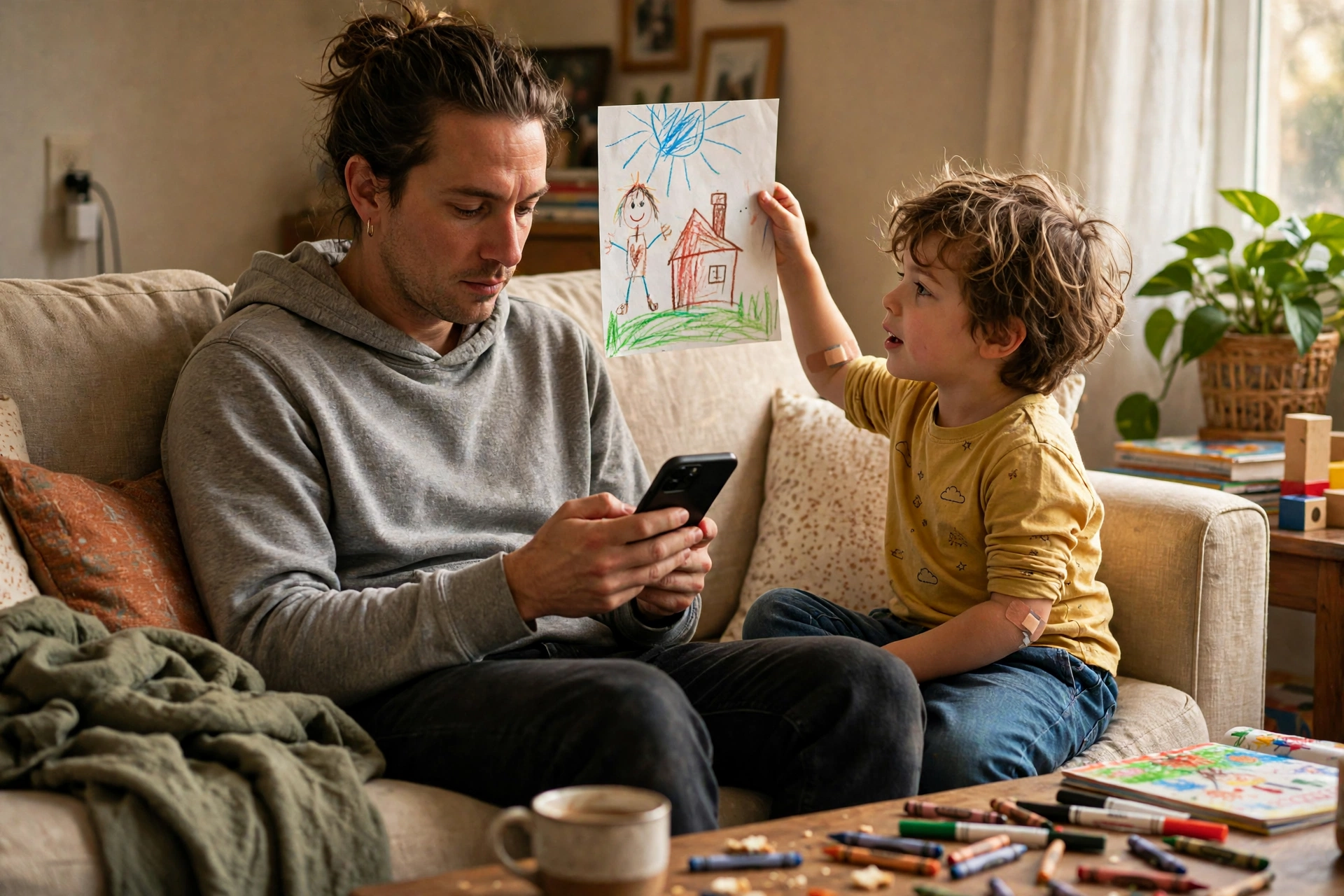
    A child reaching for a parent's attention while the parent's phone rests nearby

    What phubbing actually is

    Phubbing is not being on your phone. It is being on your phone instead of being with the person in front of you. A parent checking a message while a child waits to be heard. A parent scrolling during playtime. A parent answering “uh-huh” without looking up.

    The word itself is new, but the behavior is not. Parents have always been distracted — by work, by worry, by the newspaper. What is new is the object: a small glowing rectangle that fits in one hand, buzzes for attention, and is designed to be hard to put down. The phone is not a villain. It is a very good interrupter, and interruptions are what children feel.

    What the research found

    The research on parental phubbing has grown fast, and it points in a consistent direction. A 2025 systematic review and meta-analysis pulled together 26 studies covering 22,833 children and 2,125 parents. It found that parental phubbing was significantly associated with more affective symptoms in children (r = 0.319), more aggressive or deviant behavior (r = 0.260), more internalizing problems (r = 0.242) and externalizing problems (r = 0.158) — and with lower self-esteem (r = −0.233).

    A 2025 study of 612 parents of children ages 3 to 7 found the same pattern in the youngest children: parental phubbing was positively associated with children’s behavioral problems (r = 0.251). Most of that link ran through two things — a harsher parenting style and more conflict between parent and child — which together accounted for almost two-thirds (64.94%) of the total effect. The phone does not only take the parent’s attention. It seems to change the tone of the whole interaction.

    And a 2025 study of 561 teenagers ages 14 to 17 and their parents found something the site’s readers will recognize at once: parental phubbing significantly predicted the teenagers’ own phubbing behavior (β = 0.521). Kids learn by watching adults. When the adults in a house put the phone first, the children do too.

    Sources: Gu & Zhao (2025), International Journal of Mental Health Promotion, DOI: 10.32604/ijmhp.2025.062796; Kos et al. (2025), Children’s Health Care, DOI: 10.1080/02739615.2025.2603601; systematic review and meta-analysis (2025), European Psychiatry, DOI: 10.1192/j.eurpsy.2025.452.

    The word behind the word: technoference

    Before “phubbing” there was “technoference” — a word researchers Brandon McDaniel and Sarah Coyne coined in 2016 for the everyday interruptions in time spent together that happen because of digital and mobile devices. Technoference is the wider idea; phubbing is what it looks like when the device is a phone and the person being interrupted is right there.

    McDaniel and Jenny Radesky then tested the idea with families. In one study of 170 US families with a young child (average age just over 3), both mothers’ and fathers’ problematic technology use predicted more technoference in everyday interactions — and the interruptions were associated with more child behavior problems, as reported by both parents.

    A follow-up study of 183 couples with a child under 5, surveyed four times over six months, found the pattern ran in both directions. Children with more externalizing behavior — tantrums, frustration, acting out — led to more parenting stress, which led to more technoference. And technoference, in turn, often predicted more externalizing behavior. It is a loop, not a one-way street. Stressed parents reach for the phone. The phone takes the parent away. The child acts out more. The parent gets more stressed.

    Sources: McDaniel & Coyne (2016), Psychology of Popular Media Culture, 5(1):85; McDaniel & Radesky (2018), Child Development, 89(1):100–109, DOI: 10.1111/cdev.12822; McDaniel & Radesky (2018), Pediatric Research, 84(2):210–218, DOI: 10.1038/s41390-018-0052-6.

    Why kids notice (and copy)

    Children do not need a study to tell them what phubbing feels like. They feel it in the half-second delay before a parent answers, in the eyes that flick down mid-sentence, in the “just a minute” that stretches into five. A child who has to compete with a phone for a parent’s attention learns something about where they stand — and then, a few years later, they do the same thing to their own friends, because that is what attention looks like in their house.

    This is the heart of the site’s message, and it is the same in every piece we have written: kids learn by watching adults. A parent who puts their own phone aside is not giving up anything. They are showing what the rule looks like when it applies to everyone. That is why our phone-free dinner and our phone-free bedtime both start with the adults.

    What the research does not say

    Two honest notes, because the research deserves them. First, most of these studies are cross-sectional — they show a strong association, not proof that the phone causes the behaviour. The longitudinal study above shows the loop runs both ways: difficult behaviour can push a parent toward the phone just as surely as the phone can push a child toward difficult behaviour. Blaming the phone alone would miss half the story.

    Second, none of this research says parents should feel guilty. It says the opposite, if you read it kindly: the interruption is small, ordinary, and fixable. Nobody in these studies was a bad parent. They were tired parents with a device designed to be irresistible, in a house full of small moments that deserved a little more of them.

    Try one small pause

    You do not need a new system, a lecture, or a perfect week. One pause is enough to start. Here is the simplest version:

    Notice the moment, not the minutes. You do not have to count your screen time. Just notice the next time your child is talking and your phone is in your hand. That noticing is the whole practice.

    Put the phone face-down. Not in another room — face-down on the table. The buzz still comes, but the glance does not. It is the smallest possible version of our screen-free zones, and it works anywhere.

    Answer the sentence, not the notification. Finish the conversation first. The message will still be there in five minutes. The sentence might not be.

    Notice what happens. That is the whole assignment. One pause, one finished sentence, and see how it feels — for you, and for them.

    A small pause, not a punishment

    We are not anti-phone. We are pro-family moments. The goal is not to quit screens or to feel guilty about the ones already in your home. It is to protect one small moment where connection already wants to happen.

    If one pause goes well, try another next week — a phone-free dinner, a phone-free bedtime. And if you would like to be part of what comes next, join the waitlist and help shape the first phone-free ritual. Read more about why these moments matter.

    This article shares research and practical ideas for families. It is not medical advice. For guidance about your own family’s media use, the AAP’s family media plan resources are a good place to start.

  • 28 Family Dinner Conversation Starters (When the Phones Are Away)

    28 Family Dinner Conversation Starters (When the Phones Are Away)

    You put the phones away. The table is quiet. And then someone says, “So… how was your day?” — and gets one word back.

    That is the moment this list is for. The phone-free pause only works if something fills it, and the something is a question worth answering. Here are 28 of them — ten for the dinner table, eight for the car, six for bedtime, and four for the grown-ups, too.

    A family sharing stories and laughter over dinner, phones set aside

    Why the question matters more than the answer

    Closed questions get closed answers. “How was school?” gets “Fine.” Open questions get stories. “What was the best part of today?” gets a sentence, and a sentence gets a follow-up, and a follow-up is a conversation.

    Researchers who filmed 98 real family car rides found that out of 851 parent questions, only 18 were open ones that asked the child to think out loud. The rest were answerable in a word or two. The fix is not more questions. It is better ones — and then waiting long enough for the answer. Count to three in your head before you say anything else. Most of the time, your child will fill the space.

    Pick one question a night. You do not need all 28. You need one that lands.

    At the dinner table

    These are for the meal itself — the first of our phone-free dinners, or the hundredth.

    1. What was the best part of your day?
    2. What was the hardest part of your day?
    3. What is something that made you laugh today?
    4. What is something kind you saw someone do today?
    5. If you could invent anything in the world, what would it be?
    6. If you could have dinner with anyone, living or not, who would it be?
    7. What are you looking forward to this week?
    8. What is something you learned today that surprised you?
    9. Tell us about a high and a low from today.
    10. What is something you are proud of this week?

    In the car

    Side by side, both looking forward, nobody having to make eye contact — the car is where the quiet questions work best. Read more in our phone-free car rides piece.

    1. What song should we play, and why that one?
    2. If you could drive anywhere right now, where would we go?
    3. What was the funniest thing that happened today?
    4. What do you wish grown-ups understood about being a kid?
    5. Tell me about a friend — what makes them a good friend?
    6. What are you curious about right now?
    7. If you could change one thing about today, what would it be?
    8. What do you think tomorrow will bring?

    At bedtime

    Short, soft, and slow — bedtime questions are for winding down, not winding up. They pair with our phone-free bedtime routine.

    1. What are you grateful for today?
    2. What are you dreaming about tonight?
    3. What made you smile today?
    4. What do you want tomorrow to hold?
    5. Tell me the beginning of a story — I will tell you the middle.
    6. What was the coziest part of today?

    For the grown-ups too

    Kids learn by watching adults, and that includes watching adults answer questions. Take a turn. Let them ask you one back.

    1. What did you love doing when you were my age?
    2. What was dinner like when you were a kid?
    3. What are you learning right now?
    4. What made you laugh today?

    How to use this list

    One question a night. Let a different person pick each night. The picker asks, everyone answers — including the adults.

    Follow the answer, not the list. If “best part of your day” turns into a ten-minute story, stay there. The list is a door, not a schedule.

    Keep it somewhere visible. Print this page, or write five favorites on a card by the table. The nights the table goes quiet are the nights the card earns its keep.

    Let the kids add their own. The best question on this list is the one your child invents. When they ask one, write it down and use it tomorrow.

    A small pause, not a punishment

    We are not anti-phone. We are pro-family moments. The goal is not to quit screens or to feel guilty about the ones already in your home. It is to protect one small moment where connection already wants to happen — and a good question is often all it takes to start it.

    If one phone-free dinner goes well, try another next week. And if you would like to be part of what comes next, join the waitlist and help shape the first phone-free ritual. Read more about why these moments matter, or start with our screen-free zones at home.

  • Screen-Free Zones at Home: Start With Three.

    Screen-Free Zones at Home: Start With Three.

    Most families do not need a new set of rules. They need a few places where the phone simply waits. A zone is easier than a rule, because a zone is a place, not a lecture. Everyone can see it. Everyone knows when they are in it.

    This is the hub piece for the three moments we have already written about — dinner, bedtime, and the car. Each one is a zone. Together, they are a day with room to breathe in it.

    Phones resting in a basket by the front door while the family gathers at home

    What a screen-free zone is

    A screen-free zone is a place or a time where phones rest and people get each other instead. The dinner table is a zone. The bedroom is a zone. The car is a zone. The zone is not a punishment for the phone. It is a protected space for the people in it.

    The American Academy of Pediatrics puts it the same way: agree on screen-free times and places together, as a family, and include the adults in the plan. The dinner table is one of the zones they name. The idea is not to ban screens from the house. It is to choose, on purpose, the moments that stay phone-free.

    The three zones to start with

    1. The dinner table. In a 2026 study published in JAMA Pediatrics, 77.6% of parents and 68.7% of children had used a device during their most recent family meal. Dinner is the one part of the day when everyone is in the same place at the same time — and the one most worth protecting. Read our phone-free dinner piece for the full story and one simple way to start.

    2. The bedroom. A meta-analysis of 20 studies covering 125,198 children found that using a device at bedtime was associated with about twice the odds of getting too little sleep. Even having a device in the bedroom, without using it, was linked to worse sleep. The phone does not have to be on to do its work. Our phone-free bedtime piece walks through what the research found and one story to replace the scroll.

    3. The car. Researchers who filmed 98 real family car rides found that 59% of car time was silence — and that the car, side by side with nowhere to go, is where some of the best conversations happen. Sport psychologist Katherine Tamminen calls it a “pod of privacy.” Our phone-free car rides piece explains why the car works and how to try one ride.

    Why three is enough

    Three zones cover the whole shape of a day: a meal together, a night of rest, and the time in between. You do not need a zone for every room. You need a few that everyone can remember without a chart on the fridge.

    Three is also small enough to keep. A family that holds three zones for a month has built something real. A family that tries to hold twelve zones for a week has built a list, and lists are easy to drop. Start with three. Let the rest follow if it wants to.

    How to agree on the zones together

    The zones work when everyone, including the adults, says yes to them. That is the whole secret, and it is the same one in every piece on this site. Sit down together and pick the three. Let the kids name one of them. Let the adults name one too. Write them down somewhere everyone can see — a sticky note on the fridge is enough.

    Agree on the edges as well. Does the bedroom zone start an hour before bed, or at the bedroom door? Does the car zone cover every ride, or the school run first? The answers matter less than the fact that the family chose them together. A rule handed down is a rule to break. A zone chosen together is a place to be.

    What goes in the basket

    Every zone needs a visible place for phones to wait. A basket by the front door. A box on the kitchen counter. A charging spot outside the bedrooms. The point is not hiding them. It is a small, visible pause everyone can see — and a small, visible promise that the phones will be right there when the moment is over.

    Keep it simple and keep it shared. The basket is not a punishment box. It is the family’s phone parking spot. When the adults’ phones go in first, the kids know the zone is real.

    A small pause, not a punishment

    We are not anti-phone. We are pro-family moments. The goal is not to quit screens or to feel guilty about the ones already in your home. It is to protect a few small places where connection already wants to happen.

    If three zones hold for a week, try a fourth — a walk, a Saturday morning, a game night. And if you would like to be part of what comes next, join the waitlist and help shape the first phone-free ritual. Read more about why these moments matter, or start with our manifesto.

    This article shares research and practical ideas for families. It is not medical advice. For guidance about your own family’s media use, the AAP’s family media plan resources are a good place to start.

  • The Small Moments Are the Ones They Remember.

    The Small Moments Are the Ones They Remember.

    Some of the best conversations with your kids happen in the car. Not at the dinner table, where everyone is facing each other and the questions feel like an interview. In the car, side by side, both looking forward, with nowhere to go until you arrive.

    Researchers have actually studied this. And what they found is both encouraging and a little uncomfortable — because the car works, but mostly we waste it.

    A girl watching the sunset from the back seat on a phone-free car ride

    What the research found

    Sport psychologist Katherine Tamminen spent years studying the car ride home. Her first study, in 2017, interviewed 27 young athletes and their parents about the drive after games and practices. Then her lab went further: cameras on the windshields of 28 families, 98 real car rides, thirty hours of footage, every comment and question coded.

    The numbers are worth sitting with. Fifty-nine percent of all car time was silence. Thirteen percent was spent talking about sport. Eighty-three percent of parent questions were closed — answerable in a word or two. Out of 851 parent questions, only 18 were open ones that asked the child to think out loud. And more than half the time, when parents praised their child, they kept talking or cut in before the child could respond.

    One phrase from Tamminen explains why the car matters at all. She called it a “pod of privacy.” Two people, side by side, not face to face, nobody having to make eye contact. That setup can open up conversations a child would never have across a table.

    Two honest notes. These were families who agreed to be filmed, so they were probably on their best behavior. And the research followed young athletes and their parents, not every kind of family. But the car works the same way for anyone: the seating is the same, the silence is the same, and the ride ends when you arrive.

    Sources: Tamminen et al., 2017 (DOI: 10.1037/spy0000093); Tamminen et al., 2022 (DOI: 10.1016/j.psychsport.2021.102095). Figures as reported in “The Car Ride Home,” Coach Saltmarsh, which links both studies.

    Why the car works

    At the dinner table, a hard question lands face to face. In the car, it lands side by side, while both of you are watching the road. Nobody has to perform a reaction, and nobody has to explain why they went quiet. The gaze is already somewhere else, which is exactly what makes room for the real answer.

    The car also solves the problem every hard conversation has: how long will this run, and how does it end? In the car, everyone already knows. The conversation ends when you arrive. Nobody has to negotiate an exit, and nobody is trapped at the table waiting for it to be over.

    And a quiet car is normal. Nearly six in ten minutes in those filmed rides were silence. Silence in the car is not a failed ride. It is the space where a child decides whether to talk — and they can only decide that if nobody fills it first.

    What gets in the way

    The same research shows how the ride goes wrong, and phones are usually in the middle of it. Headphones go in. Eyes go to the window. Some of the young athletes in the study admitted they pretended to fall asleep to avoid talking about the game — taking control of a conversation they did not want.

    Parents do their version of the same thing. A call on speaker. A quick check at a red light. A playlist that fills every gap so the silence never gets a chance. The car is a small room, and a phone in it takes up more space than it looks like it should.

    None of this is about blame. The ride is the one place in the day where nobody can leave the room, which is exactly why it deserves the same small pause as the dinner table and the bedtime story.

    Try one phone-free car ride this week

    You do not need a new system, a lecture, or a perfect week. One ride is enough to start. Here is the simplest version:

    Agree on it together. Pick one regular ride this week — school pickup, practice, the grocery run — and decide as a family that phones wait. Let everyone, including the adults, say yes to it.

    Give phones a visible place to wait. The seat-back pocket works. The point is not hiding them. It is a small, visible pause everyone can see.

    Ask one open question, then wait. Not “How was school?” — that gets one word. Try “What was the best part of today?” or “What was the toughest part?” Then count to three in your head before you say anything else. Most of the time, your child will fill the space.

    Notice what happens. That is the whole assignment. One ride, one question, and see how it feels.

    A small pause, not a punishment

    We are not anti-phone. We are pro-family moments. The goal is not to quit screens or to feel guilty about the ones already in your home. It is to protect one small moment where connection already wants to happen.

    If one phone-free car ride goes well, try another next week. And if you would like to be part of what comes next, join the waitlist and help shape the first phone-free ritual. Read more about why these moments matter, or start with our phone-free dinner and phone-free bedtime.

    This article shares research and practical ideas for families. It is not medical advice. For guidance about your own family’s media use, the AAP’s family media plan resources are a good place to start.

  • Bedtime Stories, Not Bedtime Scrolling.

    Bedtime Stories, Not Bedtime Scrolling.

    The last hour of the day sets up the night. For a lot of families, that hour now ends the same way the rest of the day does — with a screen. One more video, one more scroll, one more game, and then the lights go out and everyone is expected to fall asleep on command.

    It rarely works that way. And the research on bedtime screens is some of the clearest in all the family-media literature.

    Mother and son sharing a phone-free bedtime story, phone face-down on the nightstand

    What the research found

    A systematic review and meta-analysis published in JAMA Pediatrics pulled together 20 studies covering 125,198 children and teenagers. The finding was consistent: children who used a phone or tablet at bedtime had about twice the odds of getting too little sleep — and nearly three times the odds of feeling sleepy during the day.

    One detail is worth sitting with. Simply having a device in the bedroom, even without using it, was also linked to worse sleep. The phone does not have to be on to do its work. Its presence is enough to keep the brain on standby.

    An honest note: these studies were cross-sectional, which means they show a strong association, not proof that the phone causes the lost sleep. But the pattern held across 20 studies and more than a hundred thousand children, and it points in the same direction every time.

    Source: Carter B et al., “Association Between Portable Screen-Based Media Device Access or Use and Sleep Outcomes,” JAMA Pediatrics (2016). DOI: 10.1001/jamapediatrics.2016.2341.

    Why the last hour matters

    Screens push against sleep in three ways at once. The light tells the brain it is still daytime. The content — a game, a video, a conversation — keeps the nervous system alert long after the screen goes dark. And the time itself is displaced: an hour spent scrolling is an hour not spent asleep.

    That is why the hour before bed is the one the pediatric guidance singles out. The American Academy of Pediatrics recommends no screens in the hour before sleep, and no devices in the bedroom at all. It is not a moral judgment. It is a description of the conditions a brain needs to wind down.

    There is a gentler fact on the other side of the same research. A nightly routine itself — the same steps, in the same order, every night — is linked to better sleep in young children. The story is not just the absence of a screen. It is the presence of something better.

    What the experts suggest

    The AAP’s advice for families is deliberately simple: agree on screen-free times and places together, and include the adults in the plan. Bedtime is one of the zones they name, alongside the dinner table. Their family media plan tool walks through exactly this — pick the moments that stay phone-free, write them down together, and revisit them as kids grow.

    The part that matters most is the same as at dinner. Children notice what adults do far more than what adults say. A parent who charges their own phone outside the bedroom is not giving up anything. They are showing what the rule looks like when it applies to everyone.

    Learn more: AAP / HealthyChildren — How to Make a Family Media Plan.

    Try one phone-free bedtime this week

    You do not need a new system, a lecture, or a perfect week. One bedtime is enough to start. Here is the simplest version:

    Agree on it together. Pick one night this week and decide as a family that the last hour is phone-free. Let everyone, including the adults, say yes to it.

    Give phones a place to sleep, too. One charging spot, outside the bedrooms. The point is not hiding them. It is a small, visible pause everyone can see.

    Replace, don’t just remove. One story, read out loud. That is the whole assignment. The story is what the hour is for — the phone was only ever filling it.

    Notice what happens. That is the whole assignment. One bedtime, one story, and see how the morning feels.

    A small pause, not a punishment

    We are not anti-phone. We are pro-family moments. The goal is not to quit screens or to feel guilty about the ones already in your home. It is to protect one small moment where connection already wants to happen.

    If one phone-free bedtime goes well, try another next week. And if you would like to be part of what comes next, join the waitlist and help shape the first phone-free ritual. Read more about why these moments matter, or start with our phone-free dinner.

    This article shares research and practical ideas for families. It is not medical advice. For guidance about your own family’s media use and sleep, the AAP’s family media plan resources are a good place to start.

  • The Dinner Table Has Changed. One Small Pause Can Bring It Back.

    The Dinner Table Has Changed. One Small Pause Can Bring It Back.

    Food has always had a way of bringing people together. At the dinner table, families share more than a meal. They share stories, catch up on the day, and talk through whatever is on their minds.

    The scene at the table has changed, though. Everyone still sits down together, but attention often drifts from the conversation to the device in someone’s hand. If that sounds familiar, you are far from alone — and a phone-free family dinner this week is a good place to start.

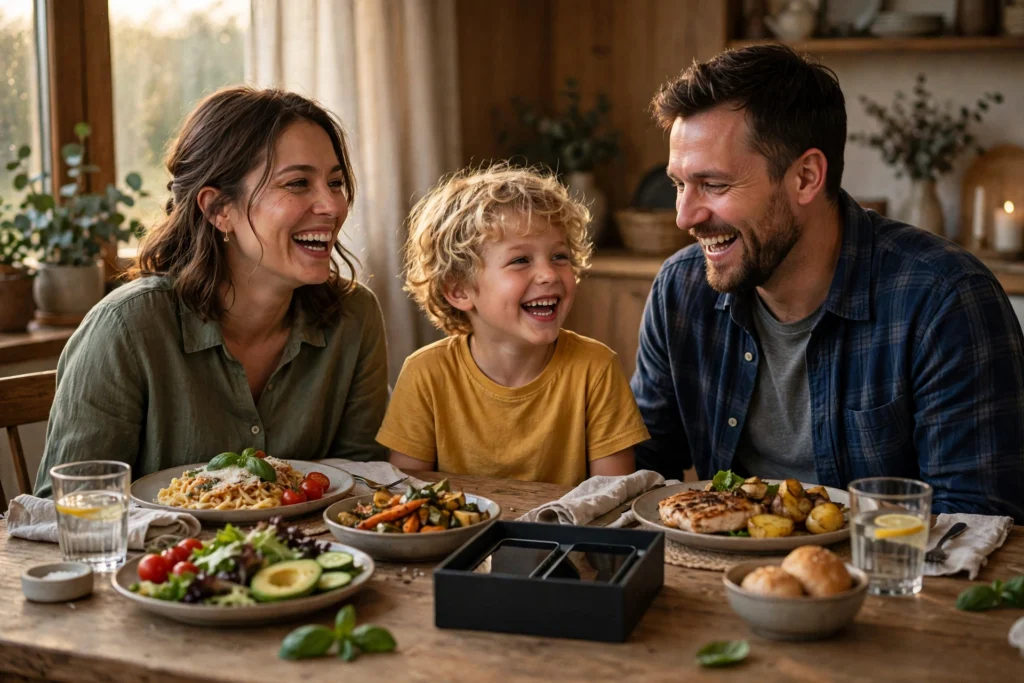
    Family laughing together at a phone-free family dinner with phones resting in a black box

    What the research found

    A 2026 study published in JAMA Pediatrics asked 357 parents of children ages 4 to 10 about their most recent family meal. The numbers were striking: 77.6% of parents and 68.7% of children had used a device during that meal. In more than two-thirds of households, parent and child were both using media at the same time.

    Parents were most often on smartphones. Children were usually watching television or a tablet. And one detail stands out: one person’s media use did not prompt the other’s. The habit is individual, not contagious — which means the fix can start with any one person at the table.

    Source: Phys.org, “Screens dominate the dinner table” (June 18, 2026), reporting on Jiawen Wu et al., “Parent and Child Media Use During Family Meals in US Households,” JAMA Pediatrics (2026). DOI: 10.1001/jamapediatrics.2026.2182.

    Why one meal matters

    For many families, dinner is the only part of the day when everyone is in the same place at the same time. It is a daily chance to connect, to stay involved in each other’s lives, and to give children the everyday guidance and attention that help them grow.

    When devices interrupt that conversation, it is children who lose out. They get less of the attention and back-and-forth that shared meals are for. None of this is about blame. Phones are useful, and modern life runs on them. But some moments deserve our full attention, and dinner is one of them.

    What the experts suggest

    The American Academy of Pediatrics recommends that families set screen-free times and places together — and the dinner table is one of the zones they name. Their guidance is deliberately balanced: there is no single magic hour limit. What matters is agreeing, as a family, on the moments that stay phone-free, and including the adults in the plan.

    That last part is the key. Children notice what adults do far more than what adults say. When parents put their own phones aside, the rule stops being a rule for kids and becomes something the whole family shares.

    Learn more: AAP / HealthyChildren — How to Make a Family Media Plan.

    Try one phone-free family dinner this week

    You do not need a new system, a lecture, or a perfect week. One meal is enough to start. Here is the simplest version:

    Agree on it together. Pick one dinner this week and decide as a family that phones wait. Let everyone, including the adults, say yes to it.

    Give phones a visible place to wait. A basket, a box, a spot on the counter. The point is not hiding them. It is a small, visible pause everyone can see.

    Start with one question. “What was the best part of your day?” is enough. The conversation does the rest.

    Notice what happens. That is the whole assignment. One meal, one question, and see how it feels.

    A small pause, not a punishment

    We are not anti-phone. We are pro-family moments. The goal is not to quit screens or to feel guilty about the ones already in your home. It is to protect one small moment where connection already wants to happen.

    If one phone-free family dinner goes well, try another next week. And if you would like to be part of what comes next, join the waitlist and help shape the first phone-free ritual. Read more about why these moments matter, or start with our manifesto.

    This article shares research and practical ideas for families. It is not medical advice. For guidance about your own family’s media use, the AAP’s family media plan resources are a good place to start.