
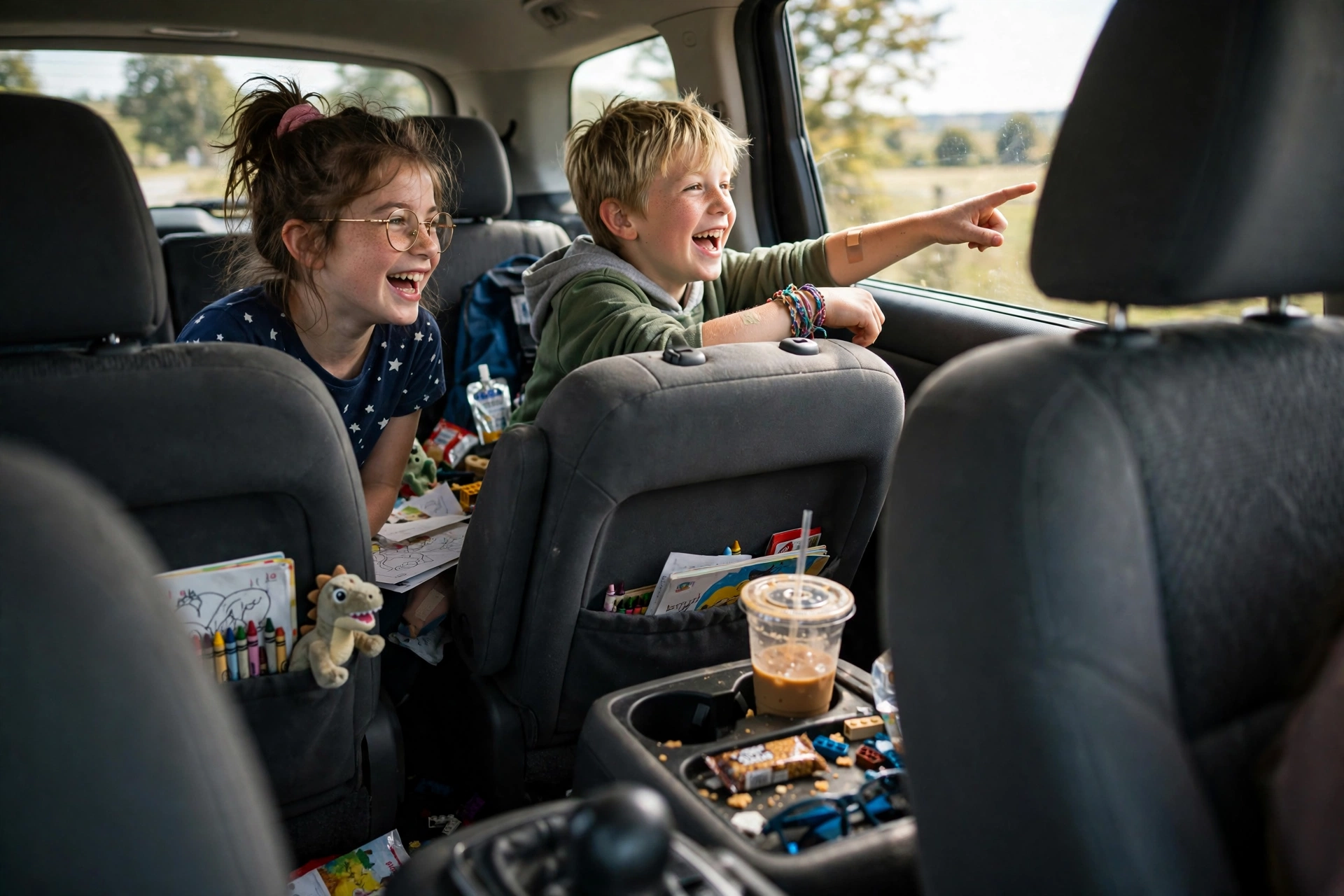
Car games for kids without screens start with a sound every parent knows: the back seat going quiet, and then the small voice asking for a screen. The ride is ten minutes or two hours, and the phone is the easiest answer. It works. It also ends the conversation before it starts.
Car games are the other answer. Not a system, not a rulebook — just twenty ways to fill a ride with the people in the car instead of the glowing rectangle. These car games for kids without screens work on the school run and they work on the long drive. Pick one before you leave, or let the kids pick. The only rule is the one that makes the rest work: the phones wait.
If you have not tried a phone-free car ride yet, start with our phone-free car rides piece — one ride, one open question, and see how it feels. These games are what you do once the phones are away.
Looking out the window: car games for kids without screens
- I Spy, with a twist. Classic I Spy, but the spy can also choose something you can hear — “I spy with my little ear, something that hums.” It keeps younger kids in the game.
- Alphabet Hunt. Work through the alphabet using letters on signs, plates, and shopfronts, in order. A is easy. Q will take a while. First to Z wins — or just see how far the family gets before you arrive.
- License Plate Game. Each person picks a letter, and the first to spot it on a plate scores. Or collect a plate from as many states as you can. The car becomes a map.
- Color Hunt. Call a color. Everyone finds something that color outside the window. First to spot it calls the next color. Simple enough for a four-year-old, fast enough for a teenager.
- Count the red cars. Pick a color and count. First to ten wins the round — then pick a harder color. It sounds too simple until two kids are shouting about a red truck three lanes over.
Talking games
- 20 Questions. One person thinks of something — an animal, a place, a person everyone knows — and the rest ask yes-or-no questions. Twenty questions is generous. Most rounds end by twelve.
- Would You Rather. Would you rather be able to fly or be invisible? Live in a treehouse or a lighthouse? The questions are the easy part. The arguing about the answers is the game.
- Story Chain. One person starts a story with a single sentence. The next person adds a sentence. Keep going around the car until the story collapses — it always does, usually around the third dragon.
- Two Truths and a Lie. Each person says three things about themselves: two true, one made up. The car guesses the lie. Kids are better at this than adults expect, and worse at hiding it.
- Fortunately, Unfortunately. One person starts with a fortunate event — “Fortunately, we found a treasure map.” The next person adds an unfortunate twist — “Unfortunately, it was written in a language nobody speaks.” Alternate until the story ends, usually in disaster, usually laughing.
Quiet games
- Hum That Tune. Hum the first line of a song. Everyone else guesses it. No words, no humming the title — the tune has to do the work. Nursery rhymes for little kids, theme songs for older ones.
- Memory Chain. “I went to the store and bought an apple.” The next person repeats it and adds an item: “I went to the store and bought an apple and a bicycle.” Keep going until someone forgets — then start again with something sillier.
- Who Am I? One person is an animal, or a person everyone knows. The rest ask yes-or-no questions to figure out who. “Am I bigger than a dog?” is a better question than it sounds.
- Animal Alphabet. A is for Alligator, B is for Bear, C is for Cat. Go through the alphabet with animals only. X is the hard one. There is always a child who knows that X is for Xenops, and they will not let you forget it.
- The Quiet Game. Everyone stays silent for one minute. The first person to laugh or talk loses. It never lasts a minute. That is the point — the silence is the game, and the giggling is the win.
For the long haul
- Road Trip Bingo. Before you leave, draw a quick card each: a red truck, a dog, a bridge, a windmill, a tractor. First to spot them all wins. No printer needed — a piece of paper and a pen is enough.
- Scavenger Hunt. Make a list of ten things to find before you arrive: a yellow house, a person walking a dog, a church, a river, a funny sign. The list is the game. The arguing over whether that counts as a river is also the game.
- The Name Game. One person names a celebrity or character. The next person names someone whose first name starts with the last letter of the last name. “Taylor Swift” becomes “Tom Hanks” becomes “Selena Gomez” becomes “Zendaya.” It falls apart fast, and that is half the fun.
- One-Word Story. Same as Story Chain, but one word at a time. “Once.” “Upon.” “A.” “Time.” “There.” “Was.” “A.” “Dragon.” The story goes strange within seconds, which is exactly why kids love it.
- Finish the Sentence. One person starts: “The best thing about today was…” Everyone finishes it in turn. Then: “Tomorrow I hope…” It looks like a game. It is also, quietly, the best conversation of the ride.
A few ground rules (that make the games work)
Let the kids pick. A game you impose is a chore. A game they chose is a plan. Keep this list in the glove box or on the fridge, and let whoever is bored choose the next one.
Play too. The games only work if the adults play. A parent on a phone while the kids play I Spy is not a family game — it is an audience. Put the phone in the seat-back pocket and play the round.
Quit while it is fun. The point is not to finish all twenty games. The point is one ride where the car felt like a room the family was in together. When the game ends, let it end. Silence after a good game is not a problem. It is the space where a child decides whether to talk.
A small pause, not a punishment
We are not anti-phone. We are pro-family moments. The goal is not to quit screens or to feel guilty about the ones already in your home. It is to protect one small moment where connection already wants to happen.
If one ride full of games goes well, try another next week. And if you would like to be part of what comes next, join the waitlist and help shape the first phone-free ritual. Read more about why these moments matter, or start with our phone-free car rides, phone-free dinner and phone-free bedtime.
This article shares research and practical ideas for families. It is not medical advice. For guidance about your own family’s media use, the AAP’s family media plan resources are a good place to start.