
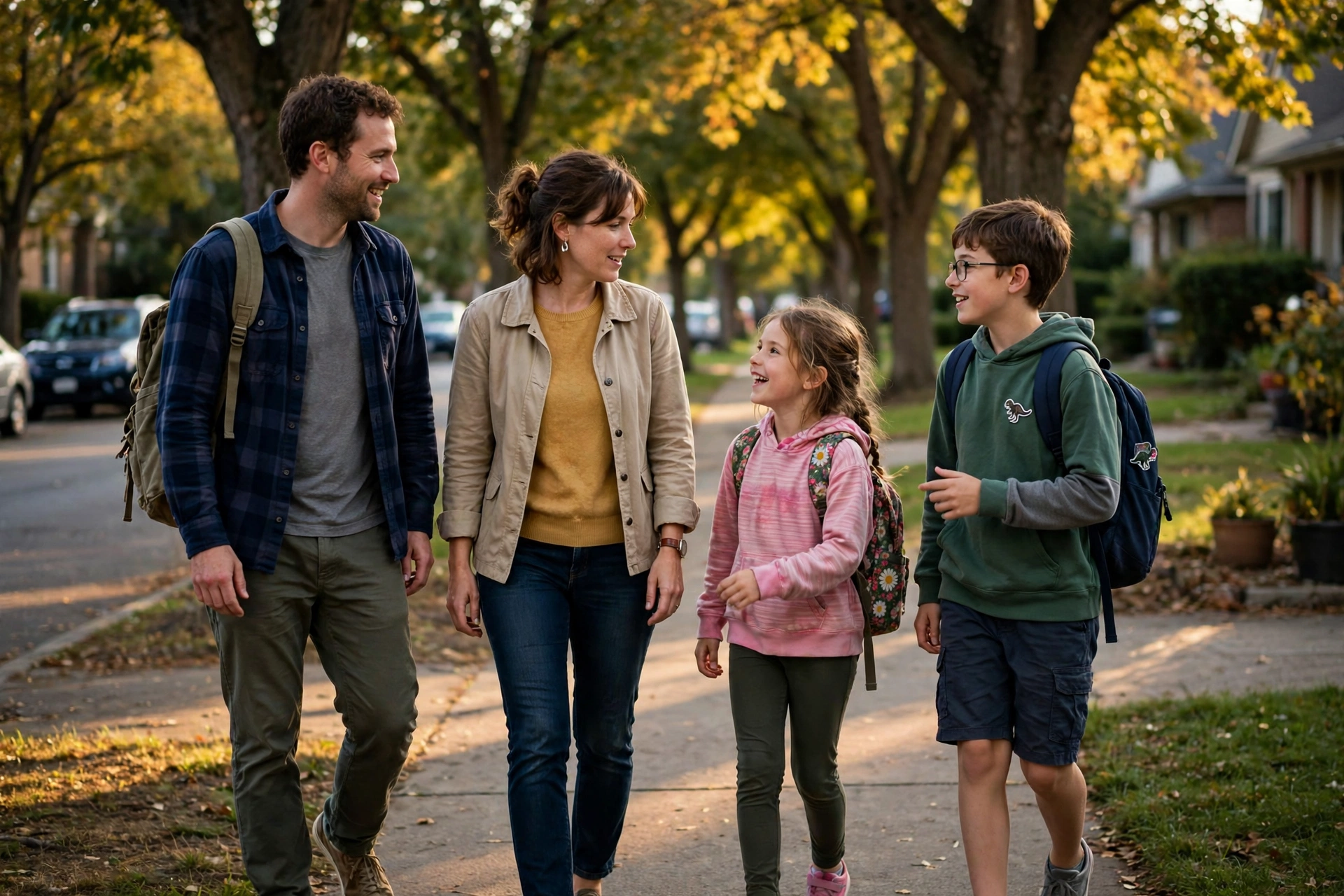
There is a moment in most families that nobody has claimed yet: the walk. Not a hike, not exercise, not an outing with a destination. Just twenty minutes, out the front door, everyone walking in the same direction, no phones.
It is the smallest of our phone-free moments, and it might be the easiest to start. Dinner needs a table and a meal. Bedtime needs a routine. A walk needs shoes.
Your phone can wait. This moment cannot. The walk is where that sentence is easiest to keep.
What the walk looks like
It looks like nothing special, and that is the point. After dinner, or before bed, or on a Saturday morning when the house feels loud: shoes on, phones on the counter, out the door. Around the block. To the end of the street and back. Twenty minutes is enough. Ten is enough, the first time.
There is no destination and no agenda. You are not walking to anything. You are walking with each other, which is a different thing, and the difference is the whole idea.
Leave the phones at home. Not in a pocket on silent — at home, on the counter, where they cannot buzz. A phone in a pocket is still a phone in the room. A phone at home is a walk. It is the same visible place to wait we use in our screen-free zones at home: the pause everyone can see.
What to do with the quiet
The first few minutes of a phone-free walk are often quiet, and the quiet can feel awkward. Nobody is used to it. That is normal. The quiet is not a failed walk. It is the space where a child decides whether to talk — and they can only decide that if nobody fills it first.
Walking helps, because nobody has to make eye contact. Side by side, both looking forward, the same setup that makes phone-free car rides work. A hard question lands more gently when you are walking than when you are sitting across a table from each other.
If the quiet stretches, ask one open question, then wait. “What was the best part of today?” “What are you looking forward to?” Then count to three in your head before you say anything else. Most of the time, your child will fill the space.
And notice things together. The point of the walk is not the talking. It is the noticing — the dog, the strange tree, the house with the blue door, the smell of rain coming. A walk gives a family something to notice together, which is a small thing and also the whole thing.
How to start
You do not need a new system, a lecture, or a perfect week. One walk is enough to start. Here is the simplest version:
Pick one regular time. After dinner works for most families — the food is done, the evening is open, and the light is good. Or Saturday morning, before the day fills up. Same time, same days, so nobody has to decide.
Decide it together. Let everyone, including the adults, say yes to it. A walk the adults skip is not a family walk — it is an errand with children. The rule applies to everyone, or it is not a rule.
Start short. Ten minutes, around the block. If it goes well, go further next time. If it goes badly — rain, complaints, a meltdown on the sidewalk — go home and try again tomorrow. One bad walk does not cancel the idea.
Notice what happens. That is the whole assignment. One walk, one question, and see how it feels.
When it rains
Some days the walk does not happen. It rains. Someone is sick. The evening collapses. That is fine. A ritual is not a streak — it is something you come back to. The walk will be there tomorrow, and the day after.
And if the weather keeps you in for a week, the walk still works as an idea: the same twenty minutes, the same phones on the counter, the same question asked side by side — on the couch, or at the kitchen table, or in the car. The walk is the shape of the moment, not the pavement. If you want a bigger version of the same idea, try our one phone-free weekend: a 48-hour plan built on the same small pause.
A small pause, not a punishment
We are not anti-phone. We are pro-family moments. The goal is not to quit screens or to feel guilty about the ones already in your home. It is to protect one small moment where connection already wants to happen.
If one walk goes well, try another tomorrow. And if you would like to be part of what comes next, join the waitlist and help shape the first phone-free ritual. Read more about why these moments matter, or start with our screen-free zones and phone-free weekend.
This article shares research and practical ideas for families. It is not medical advice. For guidance about your own family’s media use, the AAP’s family media plan resources are a good place to start.