
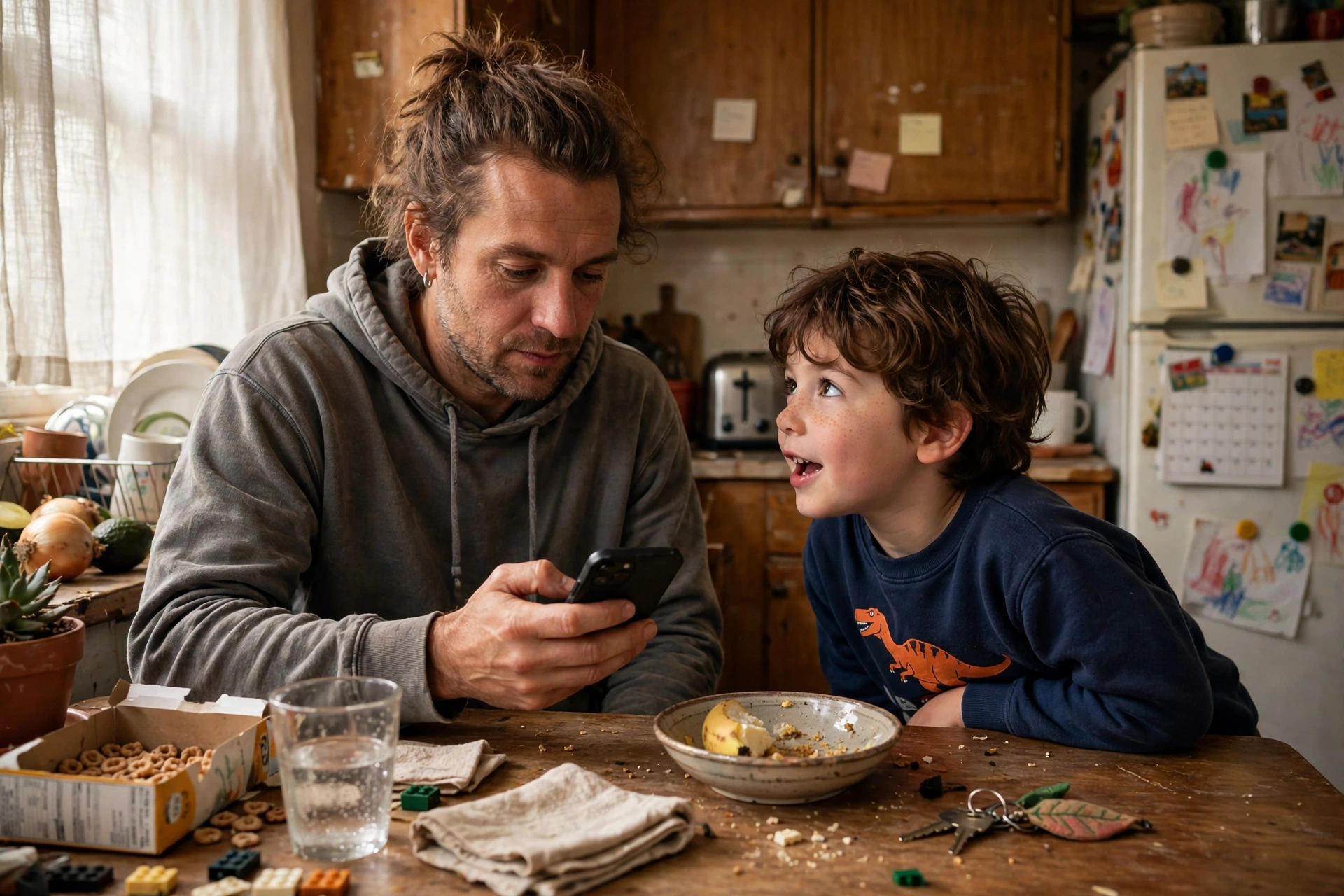
Your child is mid-sentence, telling you about their day. Your phone buzzes. You glance down — just for a second — and when you look back up, the sentence is gone. They have moved on. Or they have stopped trying.
There is a word for that moment now. It is called technoference: the everyday interruptions in time spent together that happen because of digital and mobile devices. It is the wider idea behind parental phubbing — phubbing is what technoference looks like when the device is a phone and the person being interrupted is right there.
The word is new. The research behind it is not. And what the research found is both reassuring and worth sitting with.
What technoference actually is
Researchers Brandon McDaniel and Sarah Coyne introduced the term in 2016, first for couples: the small, constant interruptions a phone causes in time spent together. Not a dramatic fight about screen time. A glance. A buzz. A conversation that pauses for a notification and never quite restarts.
McDaniel and Jenny Radesky then asked what the same interruptions do in families. Their definition is deliberately ordinary: technoference is any interruption in a conversation or activity with your child that happens because a device got in the way. A phone, a tablet, a television, a laptop — the device changes, the interruption is the same.
It is not being on your phone. It is being on your phone instead of being with the person in front of you. That distinction matters, because it is the one children feel.
What the research found
In 2018, McDaniel and Radesky surveyed 170 U.S. families with a young child — the average age was just over three. They asked both parents how often devices interrupted time with their child, and how they would describe their child’s behavior.
The interruptions were everywhere. Nearly half of parents — 48% — said devices interrupted time with their child three or more times on a typical day. Only 11% said it never happened. Four in ten mothers and about a third of fathers said they used their phone in ways they themselves would call problematic.
And the interruptions were associated with more child behavior problems, as reported by both parents — more acting out, and more withdrawing. The pattern held for mothers and fathers alike. But the study was a snapshot, not a film. It could show the link, not which way it ran.
So the same researchers followed families over time. In a second study, 183 couples with a child under five answered the same kinds of questions four times over six months. This time the pattern ran in both directions. Children with more difficult behavior led to more parenting stress, which led to more technoference. And technoference, in turn, often predicted more difficult behavior later. It is a loop, not a one-way street. Stressed parents reach for the phone. The phone takes the parent away. The child acts out more. The parent gets more stressed.
Sources: McDaniel & Coyne (2016), Psychology of Popular Media Culture; McDaniel & Radesky (2018), Child Development, 89(1):100–109, DOI: 10.1111/cdev.12822; McDaniel & Radesky (2018), Pediatric Research, 84(2):210–218, DOI: 10.1038/s41390-018-0052-6.
Why it matters at home
None of this is about blame. The research does not describe bad parents. It describes tired parents with a device designed to be hard to put down, in a house full of small moments that deserved a little more of them.
What makes technoference worth naming is that it is small enough to fix. A glance is not a lifestyle. An interruption is not a verdict on your parenting. It is a habit, and habits bend — especially the small, visible ones, the ones your children can see you change. That is the whole idea behind why these moments matter: kids learn by watching adults, and the pause is the lesson.
A glance is not a lifestyle. An interruption is not a verdict.
What the research does not say
Two honest notes. First, the first study was a snapshot — it shows a strong association, not proof that the phone causes the behavior. The second study shows the loop runs both ways: difficult behavior can push a parent toward the phone just as surely as the phone can push a child toward difficult behavior. Blaming the phone alone would miss half the story.
Second, the families in these studies were small in number, mostly from one region, and mostly well-educated — and everything was reported by the parents themselves. The findings are real, and they are not the whole picture. They are a reason to pay attention, not a reason to feel guilty.
Try one small pause
You do not need a new system, a lecture, or a perfect week. One pause is enough to start. Here is the simplest version:
Name it out loud. When the phone buzzes mid-sentence, say so: “That can wait — finish your sentence.” Naming the interruption takes its power away, and your child hears that their sentence matters more than the buzz.
Protect one moment a day. Pick one daily moment — dinner, the bath, the walk to school — and make it the one where the phone stays in another room. One protected moment is easier to keep than a whole new rule, and it is enough to show the pattern can change.
Put the phone face-down. Not in another room — face-down on the table. The buzz still comes, but the glance does not. It is the smallest possible version of our screen-free zones, and it works anywhere.
Notice what happens. That is the whole assignment. One pause, one finished sentence, and see how it feels — for you, and for them.
A small pause, not a punishment
We are not anti-phone. We are pro-family moments. The goal is not to quit screens or to feel guilty about the ones already in your home. It is to protect one small moment where connection already wants to happen.
If one pause goes well, try another next week. And if you would like to be part of what comes next, join the waitlist and help shape the first phone-free ritual. Read more about parental phubbing, or start with our phone-free dinner and phone-free bedtime.
This article shares research and practical ideas for families. It is not medical advice. For guidance about your own family’s media use, the AAP’s family media plan resources are a good place to start.