Every family already has a media plan. It is just unwritten — a pile of habits, arguments, and silent compromises that nobody agreed to and everybody resents a little. Writing it down changes that. A written plan turns a daily negotiation into a shared agreement, and it gives the whole family — adults included — something to point at.
This is the plan we have been pointing toward since the site began. It takes one evening, one sheet of paper, and everyone at the table.
What a family media plan is (and isn’t)
A family media plan is a short, written agreement about when and where screens are welcome in your home, and when and where they wait. The American Academy of Pediatrics has recommended that families make one since 2016, and they offer a free tool to build it: the AAP Family Media Plan on HealthyChildren.org, which walks through the same choices step by step.
What it is not: a contract, a punishment, or a set of rules handed down by the adults. The plans that last are the ones the whole family builds together, in plain language, on one page. If it takes more than a page, it is too long to live on a fridge.
Start with the 5 Cs
Before you write a single rule, the AAP offers five questions worth asking about any screen decision. They call them the 5 Cs, and they are a better starting point than a clock:
Child. Who is this particular child — their age, temperament, and needs? Not every child needs the same plan.
Content. What are they actually watching, playing, or interacting with? Quality matters more than minutes.
Calm. Are screens the main way this child settles big feelings or falls asleep? If so, what else could help?
Crowding out. What is the screen pushing aside — sleep, play, reading, family time, time outside?
Communication. Do you talk about media early and often, so problems surface while they are still small?
Run each of your family’s screen habits through those five questions. The answers will tell you where the plan needs to be firm and where it can be generous. The AAP’s 2026 policy statement makes the same shift: away from a single hour limit for every child, and toward the child, the content, and the conversation.
The six steps
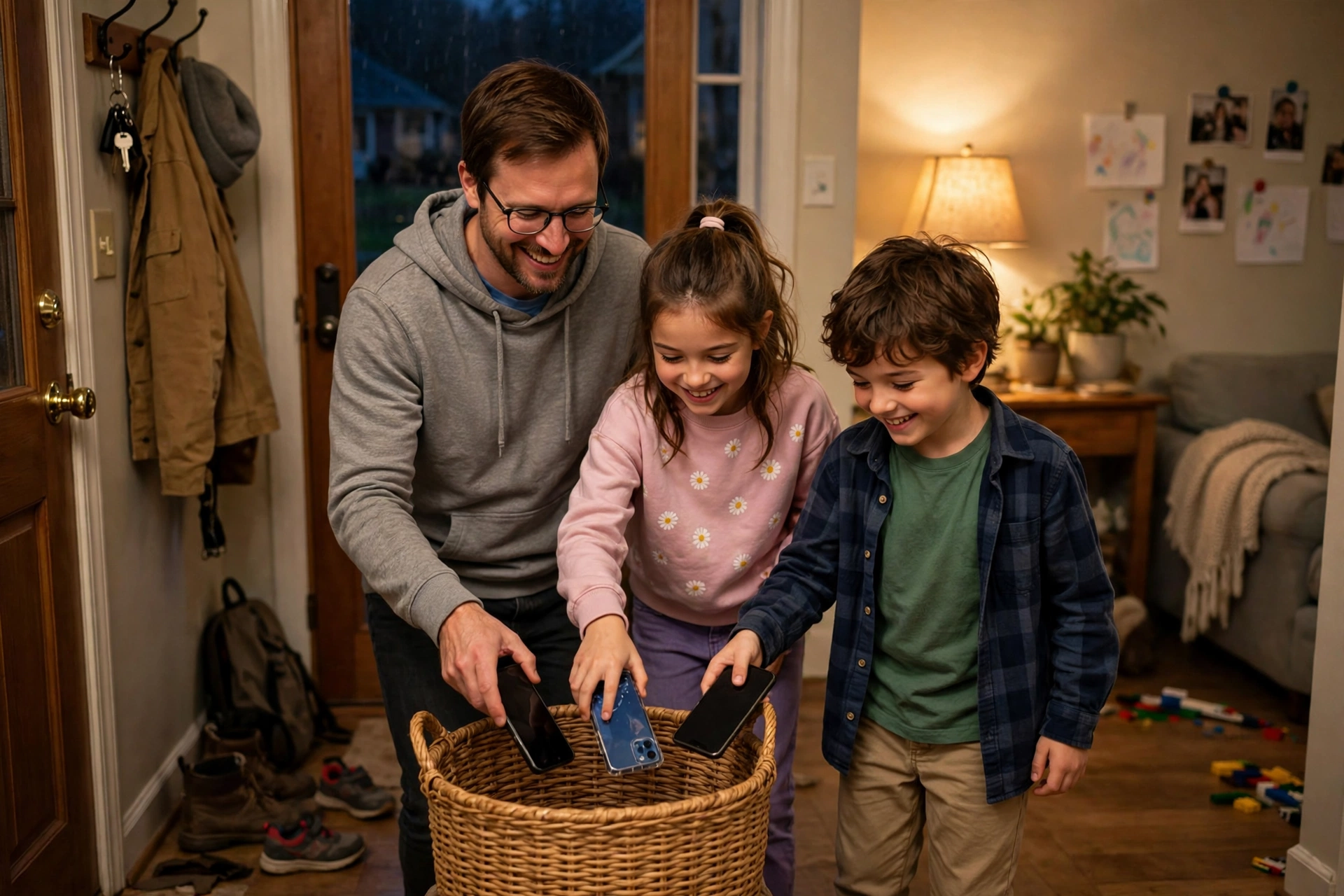
Step 1 — Pick one evening. Not a lecture, not a family meeting with an agenda. Dinner, then the plan. Twenty minutes is enough. Phones in the basket first — the adults’ too. (Our screen-free zones piece is the warm-up for this.)
Step 2 — Name the moments that stay phone-free. Start with the three we have written about: the dinner table, the bedroom, and the car. Let each person name one moment that matters to them. Write them down exactly as the family says them.
Step 3 — Name the places phones wait. Every zone needs a visible spot: a basket by the door, a charging station outside the bedrooms, a box on the kitchen counter. The point is not hiding the phones. It is a small, visible pause everyone can see.
Step 4 — Agree on the edges. What happens when a grandparent video-calls at dinner? When homework needs a tablet? When a teenager is waiting for a message from a friend? Write the exceptions in. A plan with no exceptions is a plan that breaks the first time life happens.
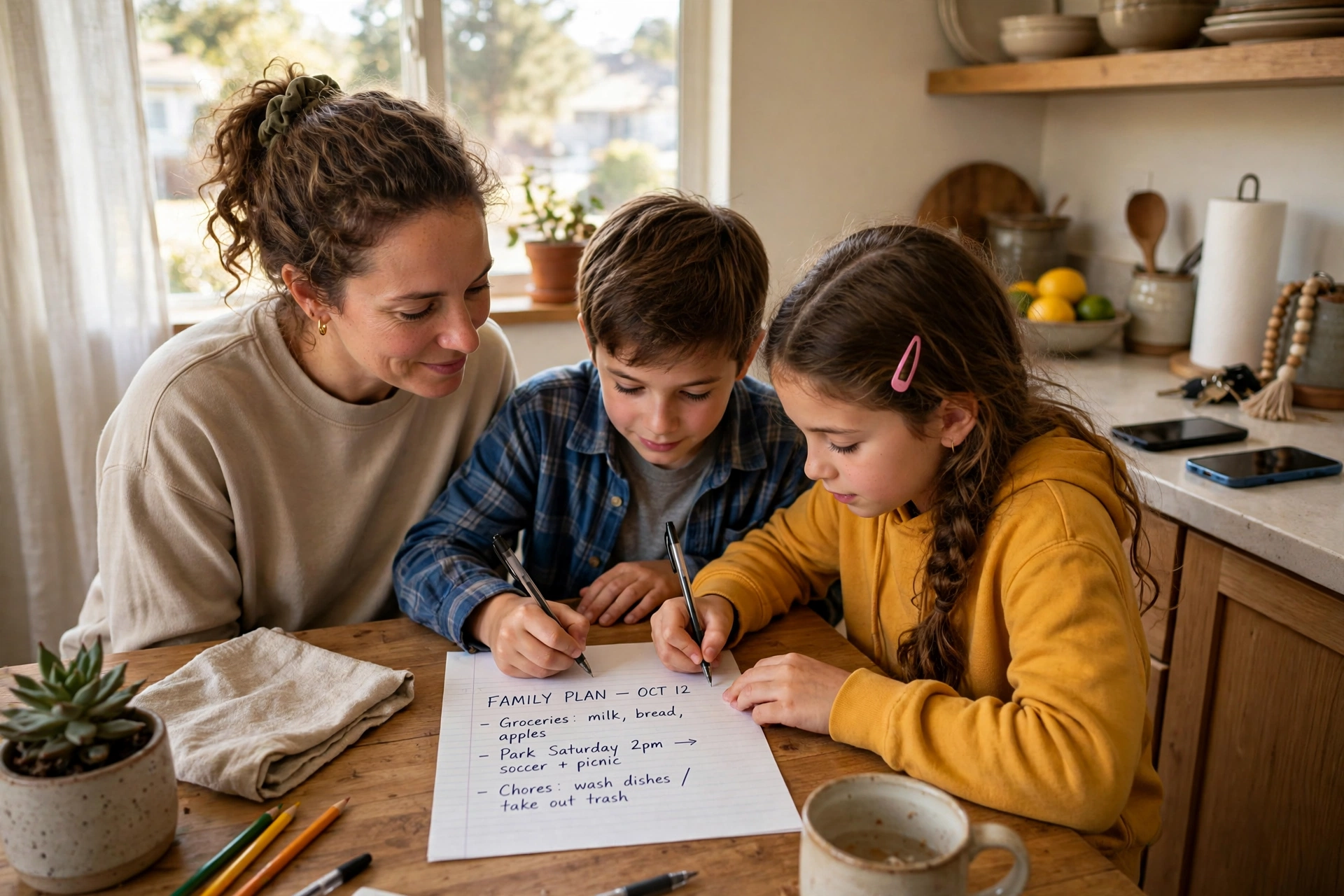
Step 5 — Write it on one page. Three zones, three phone spots, three exceptions, and one line at the bottom: “We made this together.” Sign it — all of you, including the kids. A signature is not a legal document. It is a memory of having chosen together.
Step 6 — Put it where everyone can see it. The fridge. The hall. The inside of the front door. A plan in a drawer is a plan that does not exist.
The one-page plan
Here is the template. Copy it onto a sheet of paper tonight — or print this page and fill it in together:
OUR FAMILY MEDIA PLAN
Our phone-free moments: 1) Dinner — phones in the basket. 2) Bedtime — phones charge outside the bedrooms. 3) Car rides — phones in the seat-back pocket.
Where phones wait: The basket by the door / the charging spot in the hallway.
Our exceptions: Video calls with family. Homework on the tablet. Emergencies, always.
Our promise: The adults follow the plan too. We review it together every season — and we change it together when it stops working.
Signed: ____________________ (everyone signs)
That is the whole plan. It fits on one page because a plan only works if everyone can remember it.
What about the numbers?
Parents always ask for the number, so here is what the guidance actually says. For children under 5, the World Health Organization’s 2019 guidance is specific: no screen time for infants under 1, no sedentary screen time at age 1, and no more than 1 hour a day at ages 2 to 4 — and less is better. For children 6 and older, the AAP does not set one universal daily hour limit. Its 2026 policy says plainly that media and children cannot be addressed through time limits alone, and asks families to weigh the quality of the media, what it crowds out, and whether anyone is talking about it.
That is why the plan above has no hour count in it. The zones do the work the clock never could.
Review it together, every season
A plan is a living thing. Kids grow, schedules change, a new device arrives, a new school year starts. Every season — four times a year, over dinner — take the page off the fridge and ask: what is working, what is not, and what should we change? Let the kids propose the changes. The review is the point. A family that revisits its plan together is a family that keeps talking about media, and the talking is the fifth C.
If the plan falls apart for a week, that is not failure. That is a season. Put the page back on the fridge, pick one zone, and start again. One meal, one story, one ride — the small moments are where the plan lives.
A small pause, not a punishment
We are not anti-phone. We are pro-family moments. The goal is not to quit screens or to feel guilty about the ones already in your home. It is to protect one small moment where connection already wants to happen — and to write it down, together, so it lasts.
If you would like to be part of what comes next, join the waitlist and help shape the first phone-free ritual. Read more about why these moments matter, or start with our screen-free zones at home.
This article shares research and practical ideas for families. It is not medical advice. For guidance about your own family’s media use, the AAP’s family media plan resources are a good place to start.