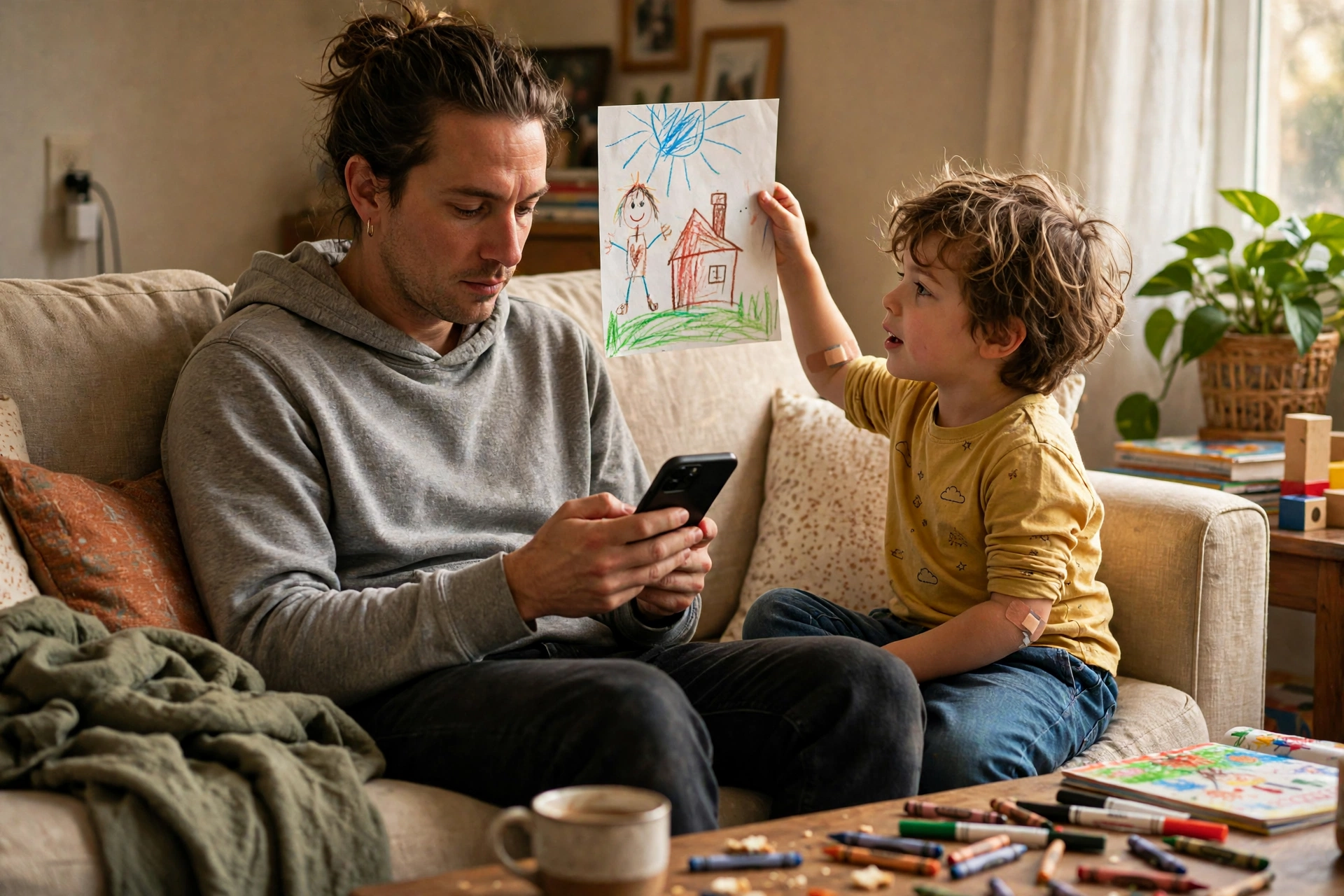
Your child is mid-sentence, telling you about their day. Your phone buzzes. You glance down — just for a second — and when you look back up, the sentence is gone. They have moved on. Or they have stopped trying.
There is a word for that moment now. It is called phubbing: phone plus snubbing. And when it is a parent doing it to a child, researchers call it parental phubbing. It is one of the most ordinary things in modern family life — and one of the most studied.
What phubbing actually is
Phubbing is not being on your phone. It is being on your phone instead of being with the person in front of you. A parent checking a message while a child waits to be heard. A parent scrolling during playtime. A parent answering “uh-huh” without looking up.
The word itself is new, but the behavior is not. Parents have always been distracted — by work, by worry, by the newspaper. What is new is the object: a small glowing rectangle that fits in one hand, buzzes for attention, and is designed to be hard to put down. The phone is not a villain. It is a very good interrupter, and interruptions are what children feel.
What the research found
The research on parental phubbing has grown fast, and it points in a consistent direction. A 2025 systematic review and meta-analysis pulled together 26 studies covering 22,833 children and 2,125 parents. It found that parental phubbing was significantly associated with more affective symptoms in children (r = 0.319), more aggressive or deviant behavior (r = 0.260), more internalizing problems (r = 0.242) and externalizing problems (r = 0.158) — and with lower self-esteem (r = −0.233).
A 2025 study of 612 parents of children ages 3 to 7 found the same pattern in the youngest children: parental phubbing was positively associated with children’s behavioral problems (r = 0.251). Most of that link ran through two things — a harsher parenting style and more conflict between parent and child — which together accounted for almost two-thirds (64.94%) of the total effect. The phone does not only take the parent’s attention. It seems to change the tone of the whole interaction.
And a 2025 study of 561 teenagers ages 14 to 17 and their parents found something the site’s readers will recognize at once: parental phubbing significantly predicted the teenagers’ own phubbing behavior (β = 0.521). Kids learn by watching adults. When the adults in a house put the phone first, the children do too.
Sources: Gu & Zhao (2025), International Journal of Mental Health Promotion, DOI: 10.32604/ijmhp.2025.062796; Kos et al. (2025), Children’s Health Care, DOI: 10.1080/02739615.2025.2603601; systematic review and meta-analysis (2025), European Psychiatry, DOI: 10.1192/j.eurpsy.2025.452.
The word behind the word: technoference
Before “phubbing” there was “technoference” — a word researchers Brandon McDaniel and Sarah Coyne coined in 2016 for the everyday interruptions in time spent together that happen because of digital and mobile devices. Technoference is the wider idea; phubbing is what it looks like when the device is a phone and the person being interrupted is right there.
McDaniel and Jenny Radesky then tested the idea with families. In one study of 170 US families with a young child (average age just over 3), both mothers’ and fathers’ problematic technology use predicted more technoference in everyday interactions — and the interruptions were associated with more child behavior problems, as reported by both parents.
A follow-up study of 183 couples with a child under 5, surveyed four times over six months, found the pattern ran in both directions. Children with more externalizing behavior — tantrums, frustration, acting out — led to more parenting stress, which led to more technoference. And technoference, in turn, often predicted more externalizing behavior. It is a loop, not a one-way street. Stressed parents reach for the phone. The phone takes the parent away. The child acts out more. The parent gets more stressed.
Sources: McDaniel & Coyne (2016), Psychology of Popular Media Culture, 5(1):85; McDaniel & Radesky (2018), Child Development, 89(1):100–109, DOI: 10.1111/cdev.12822; McDaniel & Radesky (2018), Pediatric Research, 84(2):210–218, DOI: 10.1038/s41390-018-0052-6.
Why kids notice (and copy)
Children do not need a study to tell them what phubbing feels like. They feel it in the half-second delay before a parent answers, in the eyes that flick down mid-sentence, in the “just a minute” that stretches into five. A child who has to compete with a phone for a parent’s attention learns something about where they stand — and then, a few years later, they do the same thing to their own friends, because that is what attention looks like in their house.
This is the heart of the site’s message, and it is the same in every piece we have written: kids learn by watching adults. A parent who puts their own phone aside is not giving up anything. They are showing what the rule looks like when it applies to everyone. That is why our phone-free dinner and our phone-free bedtime both start with the adults.
What the research does not say
Two honest notes, because the research deserves them. First, most of these studies are cross-sectional — they show a strong association, not proof that the phone causes the behaviour. The longitudinal study above shows the loop runs both ways: difficult behaviour can push a parent toward the phone just as surely as the phone can push a child toward difficult behaviour. Blaming the phone alone would miss half the story.
Second, none of this research says parents should feel guilty. It says the opposite, if you read it kindly: the interruption is small, ordinary, and fixable. Nobody in these studies was a bad parent. They were tired parents with a device designed to be irresistible, in a house full of small moments that deserved a little more of them.
Try one small pause
You do not need a new system, a lecture, or a perfect week. One pause is enough to start. Here is the simplest version:
Notice the moment, not the minutes. You do not have to count your screen time. Just notice the next time your child is talking and your phone is in your hand. That noticing is the whole practice.
Put the phone face-down. Not in another room — face-down on the table. The buzz still comes, but the glance does not. It is the smallest possible version of our screen-free zones, and it works anywhere.
Answer the sentence, not the notification. Finish the conversation first. The message will still be there in five minutes. The sentence might not be.
Notice what happens. That is the whole assignment. One pause, one finished sentence, and see how it feels — for you, and for them.
A small pause, not a punishment
We are not anti-phone. We are pro-family moments. The goal is not to quit screens or to feel guilty about the ones already in your home. It is to protect one small moment where connection already wants to happen.
If one pause goes well, try another next week — a phone-free dinner, a phone-free bedtime. And if you would like to be part of what comes next, join the waitlist and help shape the first phone-free ritual. Read more about why these moments matter.
This article shares research and practical ideas for families. It is not medical advice. For guidance about your own family’s media use, the AAP’s family media plan resources are a good place to start.