
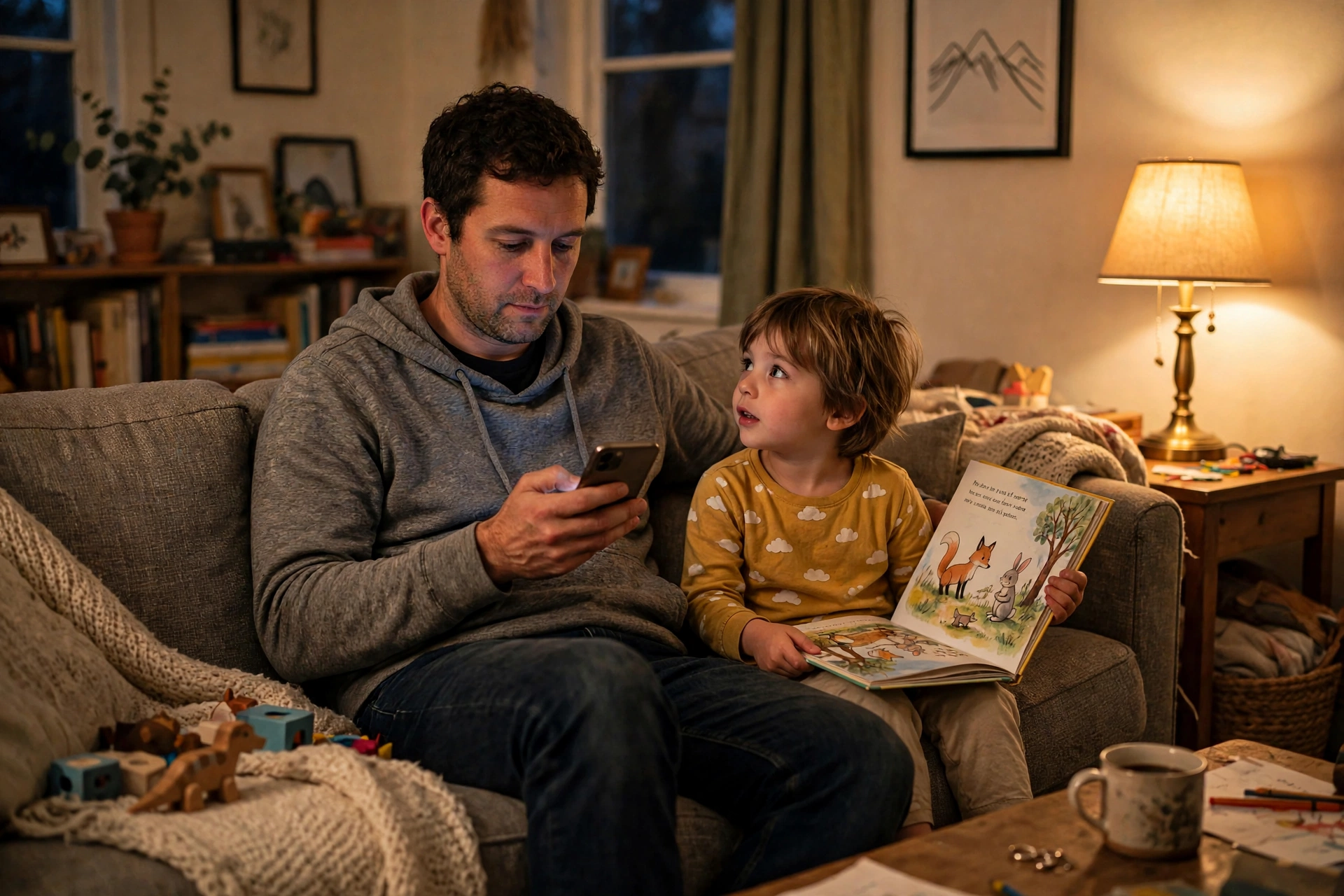
About 46% of parents say they feel addicted to their mobile devices. That figure comes from Kidslox, and it is not a statistic about bad parents. It is a statistic about honest ones — nearly half of us, saying out loud what the phone feels like in our own hands.
And our children are watching. Not in the way we fear — not keeping score, not judging. In the way children always watch: learning what normal looks like, and copying it.
This article is not a lecture. It is the other side of the one we already wrote about parental phubbing: what kids notice first, and what changes when an adult puts the phone down first.
What kids actually notice
Children do not notice your screen time. They notice the half-second delay before you answer. They notice the eyes that flick down mid-sentence. They notice the “just a minute” that stretches into five, and the sentence they were telling you that never got finished.
They notice the small things because the small things are the whole relationship. A child who has to compete with a phone for a parent’s attention learns something about where they stand — and then, a few years later, they do the same thing to their own friends, because that is what attention looks like in their house.
And they notice who goes first. A parent who puts their own phone aside is not giving up anything. They are showing what the rule looks like when it applies to everyone. That is why our phone-free dinner starts with the adults.
What the research found
The research on this has grown fast, and it points in a consistent direction. The interruptions have a name — technoference — and researchers have been measuring them for a decade. In one study of 170 families with a young child, nearly half of parents said devices interrupted time with their child three or more times on a typical day.
And children copy what they see. Our parental phubbing piece covers a 2025 study of 561 teenagers and their parents, which found that parental phubbing significantly predicted the teenagers’ own phubbing behavior. Kids learn by watching adults. When the adults in a house put the phone first, the children do too.
Read the full picture in our parental phubbing article — the studies, the numbers, and the honest notes about what the research does and does not prove.
Why willpower is the wrong tool
Most advice about phones and parenting is advice about willpower: use it less, try harder, be more disciplined. It does not work, and the reason it does not work is not a lack of character. The phone is designed to be hard to put down — the buzz, the badge, the endless scroll. Willpower against design is a fight you lose a hundred times a day.
So do not fight it. Change the setup instead. A phone in another room is not a test of willpower. A phone face-down on the table is not a test of willpower. The small, visible pause — the phone waiting where everyone can see it — does the work that willpower cannot. That is the whole idea of a ritual: it replaces a decision with a habit.
Try one small pause
You do not need a new system, a lecture, or a perfect week. One pause is enough to start. Here is the simplest version:
Pick one moment and protect it. Dinner, or the first hour after school, or bedtime. One moment a day where the phone stays in another room. Not all day — one moment.
Say it out loud. “Phones wait for dinner.” Said once, in front of everyone, it becomes a house rule instead of a private struggle. And when you say it, put your own phone down first.
Answer the sentence, not the notification. Finish the conversation first. The message will still be there in five minutes. The sentence might not be.
Notice what happens. That is the whole assignment. One pause, one finished sentence, and see how it feels — for you, and for them.
A small pause, not a punishment
We are not anti-phone. We are pro-family moments. The goal is not to quit screens or to feel guilty about the ones already in your home. It is to protect one small moment where connection already wants to happen.
If one pause goes well, try another next week. And if you would like to be part of what comes next, join the waitlist and help shape the first phone-free ritual. Read more about parental phubbing, or start with our phone-free dinner and phone-free bedtime.
This article shares research and practical ideas for families. It is not medical advice. For guidance about your own family’s media use, the AAP’s family media plan resources are a good place to start.